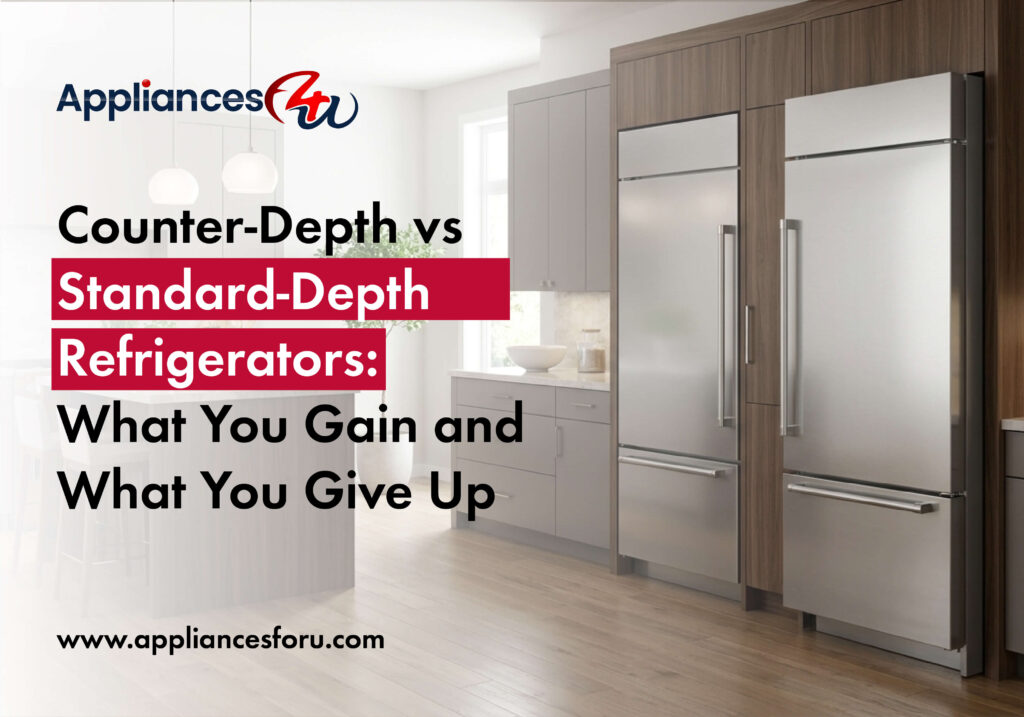
There is a moment in almost every kitchen remodel where someone stands in front of the fridge, looks at how far it sticks out past the countertop, and says “can we do something about that?”
You can. It is called a counter-depth refrigerator, and it is one of the most requested upgrades we see at our Houston showrooms. It is also one of the most misunderstood, because the trade you are making is not obvious until the appliance is in your kitchen and you are trying to fit a Thanksgiving turkey inside it.
So here is the honest version of the counter-depth vs standard-depth question. What you gain, what you give up, and how to decide which one belongs in your home.
What the two terms actually mean
Standard-depth refrigerators run roughly 30 to 36 inches deep, and once you add the door and handles, they typically stick out four to six inches past your countertops. This is the traditional refrigerator, and it is what most American kitchens were built around.
Counter-depth refrigerators are built shallower, usually around 24 to 30 inches of cabinet depth, so the body sits flush with your counters and only the doors project forward. The result is a clean, built-in look without the price of a true built-in unit.
One thing worth clearing up straight away: counter-depth is not the same as built-in. Built-in refrigerators are installed into the cabinetry, cost considerably more, and often need custom panels. Counter-depth is a freestanding fridge that simply looks built-in. You get most of the visual benefit for a fraction of the cost.
What you gain with counter-depth
A kitchen that looks finished. This is the real reason people buy them, and there is no shame in it. A fridge that lines up with your cabinets makes the whole kitchen read as intentional rather than assembled. In an open-plan home where the kitchen is visible from the living room, it changes the room.
Walkway space you can feel. Those four to six inches matter more than they sound. In a galley kitchen, or any kitchen where the island sits close to the fridge, a counter-depth model gives you room to open the dishwasher and still walk past. If two people cook in your kitchen at the same time, you will notice this every single day.
Easier reach. Shallower shelves mean less food hiding at the back. Anyone who has found a forgotten container of leftovers in the deep dark rear of a standard fridge understands the appeal. Counter-depth models tend to be wider to compensate, which spreads food out where you can actually see it.
Doors that clear. In tight kitchens, a deep refrigerator door can swing into a wall or block a doorway. Pulling the body back solves that.
What you give up
Capacity, and this is the whole trade. A counter-depth refrigerator holds less than a standard-depth model of the same width. Manufacturers work hard to close that gap, and the newer designs are genuinely clever about it, but physics is physics. If you compare like for like, you are typically losing somewhere between two and five cubic feet.
To put that in real terms: a 27 cu. ft. standard-depth French door model gives you meaningfully more room than a 23 cu. ft. counter-depth model. That difference shows up as one or two grocery bags, or as the pizza box you cannot lay flat, or as the platter that will not fit on a shelf.
Price. Counter-depth models generally cost more per cubic foot than standard-depth ones. You are paying for the design, not for the storage. That is a legitimate thing to pay for, but you should know that is what is happening.
Fewer options at the bottom of the market. Counter-depth is treated as a premium category, so the entry-level end is thinner. If your budget is tight and capacity is your priority, standard-depth simply gives you more refrigerator for the money.
How to decide
Forget the marketing and answer three questions honestly.
- How much do you actually store?
Look inside your current fridge right now. If it is packed to the point where things fall out, or if you shop in bulk, cook for a large family, or keep a lot of drinks and leftovers, capacity should win. Go standard-depth and enjoy the extra room.
If your fridge is half empty most weeks, if you shop every few days, or if you are a household of one or two, the capacity loss will never register. Go counter-depth and enjoy the kitchen.
- How tight is your kitchen?
Measure the walkway between your fridge and whatever is opposite it. If that distance is under 42 inches, a standard-depth refrigerator will make the space feel cramped and those extra inches will be worth real money to you. If you have a spacious kitchen with a wide walkway, the protrusion matters far less.
- What are you optimizing for?
Be honest. If this is a design decision, own it. A counter-depth refrigerator is a legitimate aesthetic upgrade and it will make you happy every time you walk into the room. Just do not tell yourself you are also getting more storage, because you are not.
A middle path worth knowing about
The capacity gap is smaller than it used to be. Manufacturers have gotten aggressive about reclaiming space inside counter-depth bodies, and some of the newer designs push well past what counter-depth used to mean. On our floor you will find counter-depth French door models running up to 26 cu. ft., which lands them close to the capacity of a standard-depth fridge from a few years ago.
If the flush look matters to you but you have been scared off by the storage question, these are the models to look at. They are the closest thing to having it both ways.
The other lever is width. If your opening allows a 36 inch refrigerator rather than a 33 inch one, going wider in counter-depth recovers much of what you lose in depth. Measure your opening before you assume you are stuck.
Before you buy either one, measure
This is where most refrigerator regret comes from, and it takes ten minutes to avoid.
Measure the width of your opening, the height to the underside of any cabinet above, and the depth from the back wall to the front edge of your counter. Then check the door swing: the fridge body may fit, but the doors need clearance to open fully, and on French door models the drawer needs room to pull out. Finally, measure your path into the house, meaning doorways, hallway turns and stairs. A refrigerator that fits the kitchen but not the front door is a bad day for everyone.
If you are unsure, bring your measurements into either of our Houston stores and we will work it out with you. It is a five minute conversation that saves a very expensive mistake.
The short answer
Choose counter-depth if your kitchen is open, tight, or important to you visually, and if your storage needs are moderate.
Choose standard-depth if you feed a lot of people, buy in bulk, or want the most refrigerator your money can buy.
Neither is the wrong answer. They are just answers to different questions.
See both side by side in Houston
The fastest way to settle this is to stand in front of both. We carry counter-depth and standard-depth models across French door, side-by-side and 4-door configurations, from Samsung, LG, Bosch and more, at our Southwest and Westoaks locations.
If budget is the constraint, ask about our Scratch and Dent inventory. These are the same refrigerators with cosmetic marks that often end up against a wall or out of sight anyway, and the savings can move a counter-depth model into reach. We also offer financing if you would rather spread the cost.